
Bonchon vs Pelicana vs Kyochon vs bb.q Chicken: 2026 Comparison
Korean fried chicken has quietly become one of America’s most competitive food categories. If you live in a decent-sized metro, you probably have two or three of these chains within driving distance — and they all claim to be the best. This is an independent comparison of Bonchon against its three biggest Korean fried chicken rivals: Pelicana, Kyochon, and bb.q Chicken.
Fair warning on my bias: this site is about Bonchon, so I know its menu best. But I’m going to call it straight — each of these chains does something better than the others, and the “best” pick genuinely depends on what you value.
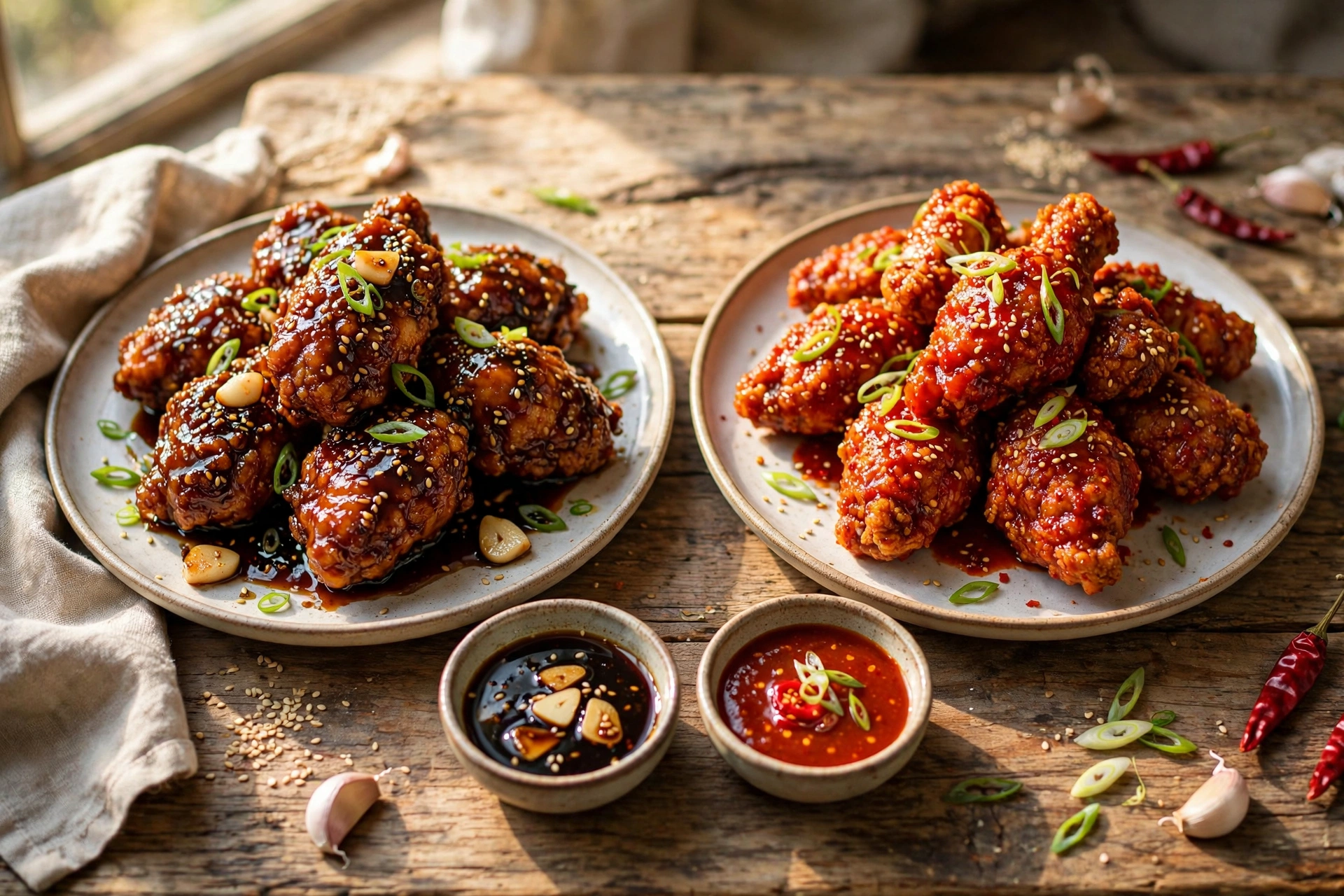
The contenders at a glance
| Bonchon | Pelicana | Kyochon | bb.q Chicken | |
|---|---|---|---|---|
| Founded | 2002, Busan, South Korea | 1982, South Korea | 1991, South Korea | 1995, South Korea |
| US presence | 100+ locations, widespread | Smaller US footprint | Growing, select metros | Large and expanding fast |
| Signature style | Double-fried, hand-brushed glaze | Classic yangnyeom + fried | Honey-crisp, lighter fry | Wide sauce variety, “K-food” positioning |
| Price range | $$ (mid) | $$ (mid) | $$–$$$ (mid-plus) | $$ (mid) |
| Menu breadth | Broad (Korean dishes, starters, sides) | Focused on chicken | Chicken-focused, premium feel | Very broad (chicken + Korean comfort food) |
Round 1: The crunch
This is the whole game in Korean fried chicken, so let’s start here.
Bonchon sets the standard. The double-fry plus hand-brushed (not dunked) sauce gives you a crust that stays audibly crispy longer than anyone else’s. It’s the crunch other chains are measured against.
Pelicana is the old soul of the group — founded in 1982, it’s the chain that arguably invented the modern yangnyeom style. Its crunch is excellent but slightly less architectural than Bonchon’s; the sauced versions can soften a touch faster.
Kyochon goes for a different texture: a lighter, honey-touched crisp that’s less shattering and more delicate. If Bonchon is a potato chip, Kyochon is a meringue. Some people prefer it — it’s less aggressive, and the honey notes are distinctive.
bb.q Chicken (the “bb.q” stands for “best of the best quality,” not barbecue) has a solid crunch, and its secret-sauce “golden olive” oil frying is a nice differentiator.
Winner: Bonchon, with Pelicana a close second for purists.
Round 2: Sauce game
Bonchon offers the most useful sauce lineup for most eaters: soy garlic (the crowd-pleaser), spicy (slow-building heat), Korean BBQ (tangy-sweet), and yangnyeom (traditional sweet-heat), plus occasional limited flavors like honey citrus. The half-and-half option — two flavors on one order — is a killer feature the others don’t match as cleanly. See our full sauce ranking.
Pelicana is the yangnyeom specialist. If you want the most traditional, deeply flavored yangnyeom in America, Pelicana is arguably the top pick. Its range beyond that is narrower, though.
Kyochon leans on its honey series — honey original, honey spicy — which are genuinely unique. Less variety overall, but what it does is distinctive.
bb.q Chicken actually wins on sheer variety: it runs the most flavors of any chain here (often 10+), including creative options like galbi, hot mala, and cheesling (cheese powder). If you get bored easily, bb.q keeps things interesting.
Winner: tie — Bonchon for the best core lineup + half-and-half flexibility; bb.q for the most adventurous variety.
Round 3: Prices and value
All four sit in the same general band — this isn’t a category with a budget disruptor. A chicken order for 2–3 people runs roughly $25–$45 at any of them before delivery fees.
- Bonchon: mid-range; strong value on lunch specials (see Bonchon lunch specials) and K-Meal group packs (catering guide).
- Pelicana: comparable to Bonchon; sometimes slightly cheaper in markets where it competes directly.
- Kyochon: tends to run a bit premium — you pay for the positioning.
- bb.q Chicken: competitive pricing with frequent promos; good value on combo boxes.
Winner: Bonchon on overall value when you factor in lunch specials and group packs — but check your local prices, since franchise pricing varies.
Round 4: Menu beyond chicken
Bonchon has the broadest Korean comfort-food menu of the four: bulgogi, japchae, bibimbap, tteokbokki, udon soup, bao buns, Korean tacos. You can bring a non-chicken eater and they’ll eat well. See the full menu.
bb.q Chicken is the other broad-menu player, with a big lineup of Korean dishes, sides, and creative chicken formats.
Pelicana and Kyochon are more chicken-focused — which is fine if chicken is why you’re there, but less ideal for mixed groups.
Winner: Bonchon, narrowly over bb.q.
Round 5: Locations and availability
Bonchon has the widest US footprint of the Korean fried chicken specialists — 100+ locations across the country, so it’s the easiest to actually find. Use our location guide.
bb.q Chicken is expanding aggressively and closing the gap fast.
Kyochon and Pelicana have smaller, more concentrated footprints — fantastic if you’re near one, irrelevant if you’re not.
Winner: Bonchon for now, with bb.q gaining.
Who should pick which?
- Pick Bonchon if: you want the crunchiest chicken, the best core sauce lineup, half-and-half orders, the broadest menu for groups, or you just want the easiest chain to find.
- Pick Pelicana if: you’re a yangnyeom traditionalist and there’s one near you — it’s the connoisseur’s pick for that specific flavor.
- Pick Kyochon if: you prefer a lighter, honey-kissed crisp and a slightly more premium experience.
- Pick bb.q Chicken if: you want maximum flavor variety and creative options, or it’s simply the closest to you.
Honestly? The right answer is to try all four over a month and decide for yourself. Korean fried chicken is one of those categories where personal texture preference matters more than any ranking.
Head-to-head cheat sheet
| If you care about… | Pick |
|---|---|
| Maximum crunch | Bonchon |
| Traditional yangnyeom | Pelicana |
| Honey-style crisp | Kyochon |
| Most flavors to try | bb.q Chicken |
| Best value lunch | Bonchon |
| Feeding a group | Bonchon (K-Meals) |
| Widest menu | Bonchon |
| Closest location | Whoever’s nearest — all four are good |
How this comparison works
The comparison uses the same core lineup for each chain where possible: a 10-piece-style wing order in the signature flavor (soy garlic or equivalent), a spicy option, and one rice or noodle side. Prices below are approximate and location-dependent; check your local store.
Sample order price check
To make the value comparison concrete, here’s what a comparable “dinner for two” (one chicken order + one side + one rice dish) ran me, approximately:
| Chain | Sample order | Approx. total |
|---|---|---|
| Bonchon | 10 wings (soy garlic) + fries + fried rice | $30–$38 |
| Pelicana | 10 wings (yangnyeom) + fries + fried rice | $28–$36 |
| Kyochon | 10 wings (honey) + sides + rice dish | $33–$42 |
| bb.q Chicken | 10 wings (galbi) + combo side + rice dish | $30–$38 |
Same ballpark, as I said — but note how quickly lunch specials or group packs (where Bonchon is strongest) change this math. A weekday lunch for two at Bonchon can come in meaningfully under these numbers.
Best pick by scenario
- Family dinner with kids: Bonchon. The broad menu means the picky eater gets strips or rice while the adults go full spicy wings, and K-Meals make the bill painless.
- Date night: Kyochon. The slightly more premium feel and honey-crisp style make it feel a touch more “night out.”
- Office lunch: Bonchon, and it’s not close — lunch specials plus group-friendly ordering win.
- Chasing the most authentic yangnyeom: Pelicana. It’s the heritage pick.
- Adventurous eating with friends: bb.q Chicken. Order five flavors, argue about rankings, have fun.
- Game-day spread: Bonchon K-Meal or bb.q combo boxes — whichever is closer, because hot and fast beats perfect.
What each chain could learn from the others
Nobody’s perfect, so here’s my honest wishlist:
- Bonchon could borrow bb.q’s flavor experimentation — a rotating limited sauce would generate real excitement.
- Pelicana could use Bonchon’s menu breadth — a few more Korean comfort dishes would help with groups.
- Kyochon could take a page from Bonchon’s lunch specials — its premium pricing needs a value entry point.
- bb.q Chicken needs Bonchon’s consistency — the quality gap between its best and average locations is the widest of the four.
The final verdict
But “best” is personal: the yangnyeom devotee will die on Pelicana hill, the honey-crisp lover won’t be moved, and the flavor adventurer belongs at bb.q. The real winner here is anyone who lives near all four — you’re spoiled, and you should act like it.

Korean fried chicken comparison FAQ
Which is better, Bonchon or Pelicana?
For crunch and menu variety, Bonchon. For the most traditional yangnyeom flavor, Pelicana. They’re the two most “authentic” feeling of the four — you won’t go wrong with either.
Is Kyochon better than Bonchon?
They’re different styles: Kyochon’s honey-crisp is lighter and less shattering than Bonchon’s double-fried crunch. Kyochon also tends to cost a bit more. Try both and pick your texture.
What does bb.q stand for?
“Best of the best quality” — it’s a Korean chain (not American barbecue), and it’s one of the fastest-growing Korean fried chicken brands in the US.
Which Korean fried chicken chain has the most locations in the US?
Bonchon has historically had the widest US footprint among the Korean fried chicken specialists, with 100+ locations. bb.q Chicken is expanding rapidly and closing the gap.
Which is healthiest: Bonchon, Pelicana, Kyochon, or bb.q?
They’re all indulgent fried chicken — none is a health food. Kyochon’s lighter fry may be marginally less heavy; Bonchon’s strips and rice dishes offer reasonable lighter orders. See our nutrition guide and is Bonchon healthy breakdown.
Which has the best sauces?
Bonchon has the best core four-sauce lineup plus half-and-half ordering; bb.q Chicken has the most flavors overall (10+). Pelicana wins for traditional yangnyeom specifically.
Last updated: October 2026. Menus, prices, and location counts change over time and vary by market — verify locally.
See also: Bonchon vs Kyochon, a closer head-to-head with one of its biggest rivals.